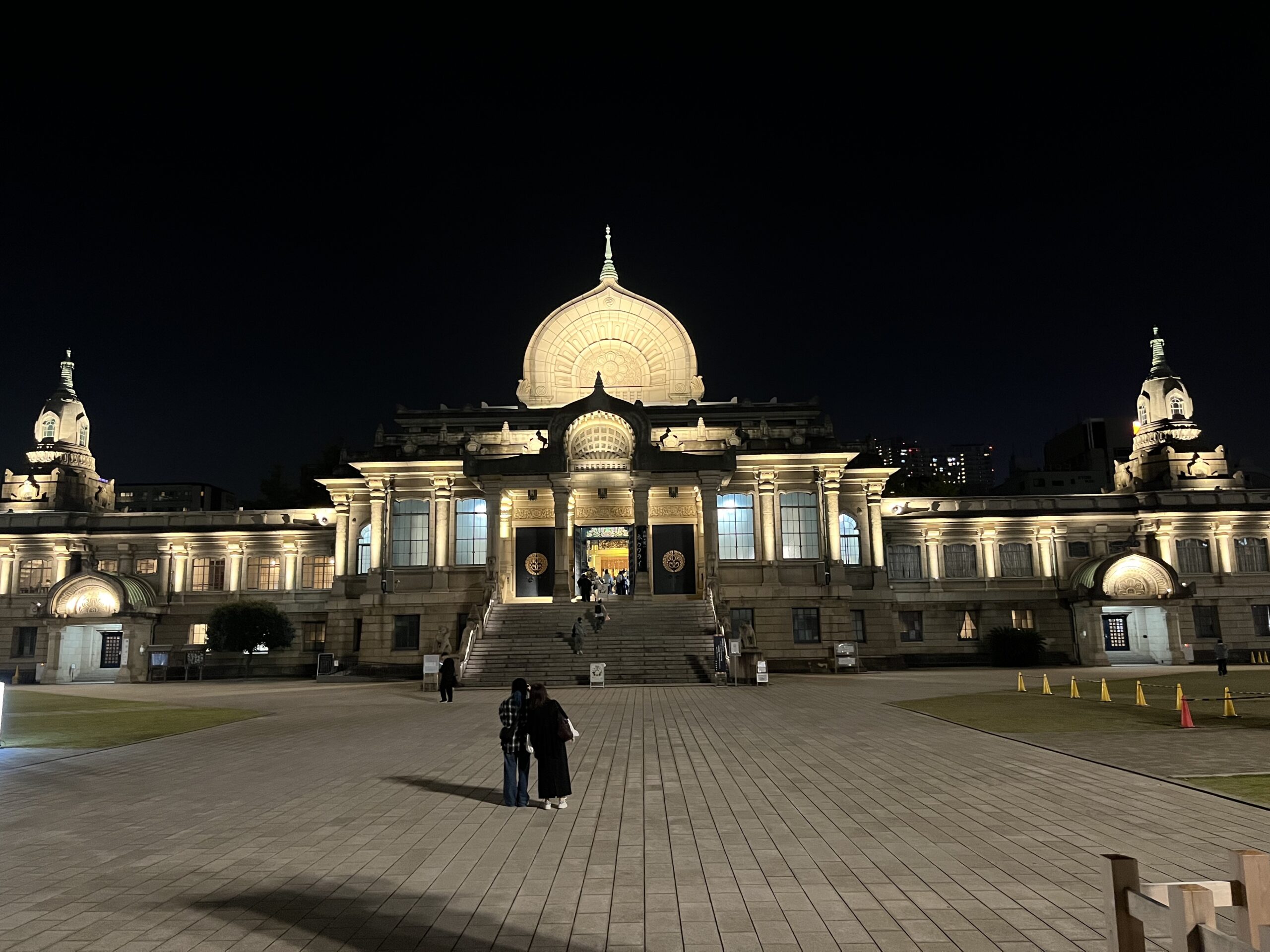
Our hotel, next to Shontimicho station was in the Tsukiji district of Tokyo. It’s just a short walk from Tsukiji Hongan-ji Temple.
It’s a prominent Buddhist temple belonging to the Jodo Shinshu sect. Its full name is “Nishi Hongan-ji,” with “Nishi” meaning “west” to differentiate it from the “Higashi Hongan-ji” (East Hongan-ji), another major temple in Kyoto.
The temple’s history dates back to the early 17th century when it was established by a priest named Junnyo Shonin. However, the temple’s current grand structure was built in the early 20th century, completed in 1934. The architectural style of Tsukiji Hongan-ji is distinctly Indian, featuring elements reminiscent of ancient Indian Buddhist architecture, particularly the Nalanda Mahavihara in India.

One of the most notable features of Tsukiji Hongan-ji is its massive, imposing structure made of concrete, which was quite innovative for its time.

The main hall, or “hondo,” is adorned with intricate carvings and decorations, and it houses a large statue of Amida Buddha, the principal deity of the Jodo Shinshu sect.

In addition to its religious significance, Tsukiji Hongan-ji has also played a role in the cultural and social life of Tokyo. The temple hosts various events, ceremonies, and cultural activities throughout the year, attracting both locals and tourists alike. The organ in Tsukiji Hongan-ji Temple is a remarkable piece of musical and cultural heritage. Installed in 1909, it is one of the oldest pipe organs in Japan and holds significant historical importance. Despite its age, it continues to be used for religious ceremonies, concerts, and other musical events, captivating audiences with its rich and resonant tones.
The Sky Tree

From Tsukiji we went to the Sky Tree in Sumida. You have to book in advance for this and you’re given a time to turn up – so we followed the rules and turned up on time. It was very busy but everything moved very smoothly because that’s what Tokyo does.
The Tokyo Skytree stands at an impressive height of 634 meters (2,080 feet), making it the tallest tower in the world and the second-tallest structure overall, surpassed only by the Burj Khalifa in Dubai. Primarily, the Tokyo Skytree serves as a broadcasting tower, transmitting television and radio signals across the Kanto region, which includes Tokyo and its surrounding areas. Additionally, it houses observation decks, shops, restaurants, and other entertainment facilities.

One of the observation decks is slanted which makes for a slightly unnerving experience. This is an exhibition for an anime character linked to the tower.

But the views are fantastic, and you can see it casts a long shadow. On clear days, visitors can see landmarks such as Mount Fuji in the distance – but not this day, which was quite hazy.
To ensure stability and safety, the Tokyo Skytree incorporates advanced seismic-resistant design features, including a central column made of reinforced concrete and a tuned mass damper system to counteract sway caused by wind and seismic activity.
The Tokyo Skytree has become a popular tourist destination, attracting millions of visitors each year who come to admire its architectural beauty, enjoy the panoramic views, and experience the vibrant atmosphere of the surrounding Skytree Town complex, which includes shopping malls, restaurants, and entertainment venues.

As part of the Sky Tree experience, there’s also an aquarium at the base of the tower. It features a diverse range of marine life, showcasing various aquatic habitats and ecosystems from around the world. Visitors can explore exhibits such as the “Rivers of the World” section, which highlights freshwater species from different continents, and the “Tokyo Bay Zone,” which showcases marine life native to Tokyo Bay.
But the most mesmerising exhibit was the Jellyfish gallery, featuring various species of jellyfish illuminated in stunning displays of light and colour.
This was our last day in Tokyo before heading south – and next morning we were catching the bullet train to Osaka.
Leave a Reply